
Is BiggerPockets Worth It for Real Estate Investors?

BiggerPockets can be worth it for real estate investors who are serious about learning, running numbers, asking better questions, and understanding how other investors think. It is not a magic shortcut, and it will not make a bad deal good. But as an education and community resource, it can be helpful if you actually use it.
A lot of people get interested in real estate investing because they hear the exciting part. They hear about cash flow, appreciation, equity, tax benefits, and financial freedom. Those things can be real, but they are not automatic. A rental property can look good online and still be a bad deal once you factor in insurance, repairs, vacancy, management, financing, and the actual tenant demand in that area.
That is where education matters. Before someone starts putting real money at risk, they need to understand the basics. They need to know how to read a deal, how to question the numbers, and how to spot assumptions that sound good but do not hold up in the real world.
I’m Tyler Gibson with the GPG Team. I work with buyers, sellers, and investors in Orlando and Central Florida, and one thing I see often is that most new investors do not need more hype. They need better information, better questions, and a more realistic view of what owning property actually looks like.
That is where a platform like BiggerPockets can help.
Disclosure: This post includes a BiggerPockets referral link. If you choose to sign up through it, I may receive a benefit at no additional cost to you.
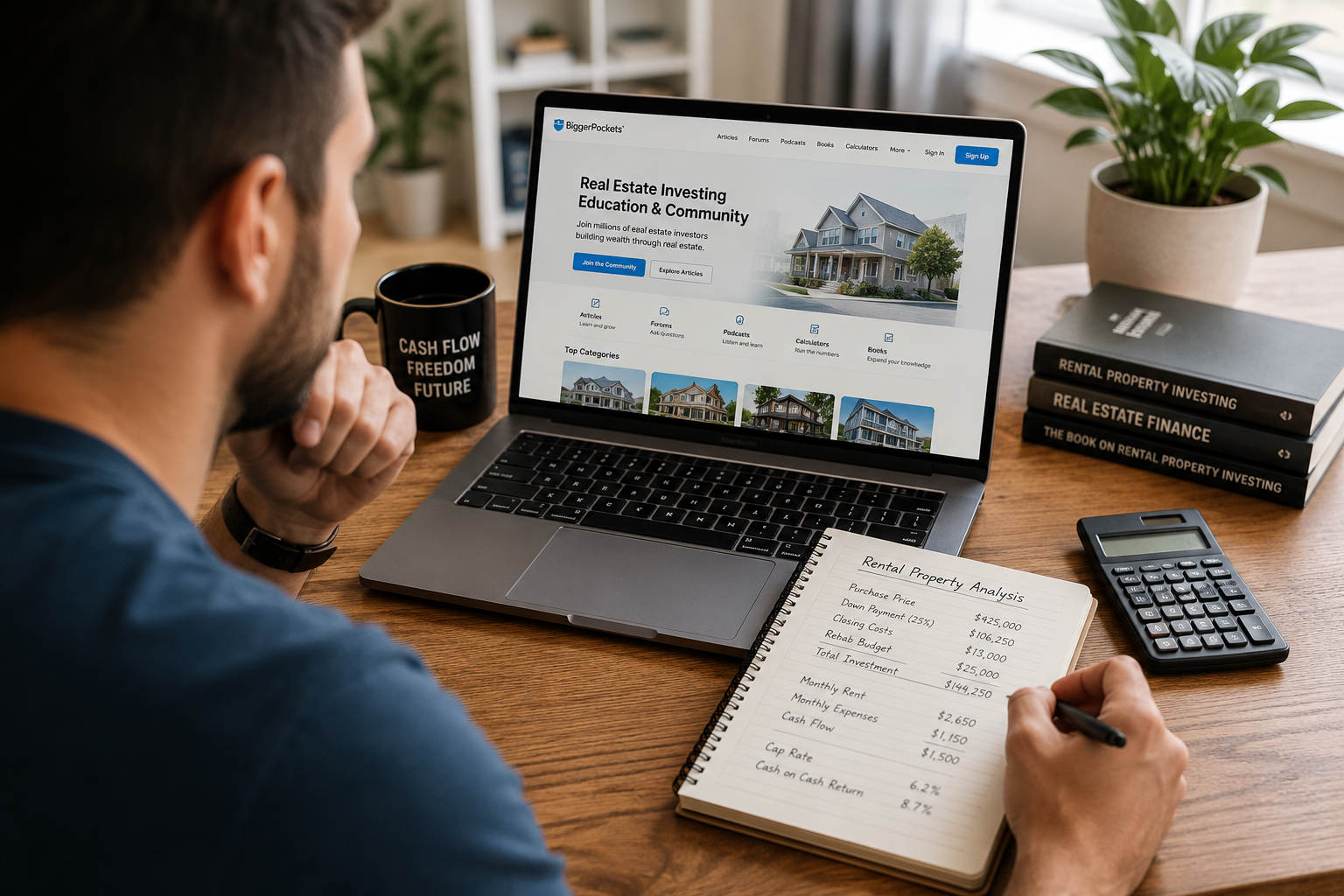
What is BiggerPockets?
BiggerPockets is a real estate investing education and community platform. It offers resources for people who want to learn about rental properties, financing, deal analysis, property management, and different real estate investing strategies.
The platform includes real estate investing articles, podcasts, forums, calculators, guides, and other tools. The value is not just one article, one podcast, or one calculator. The value is that investors can keep seeing the same concepts repeated in different ways.
You can read about a strategy, listen to someone talk through their own deal, ask questions in the forums, and start learning the language of real estate investing before you are sitting across from a lender, contractor, agent, or property manager.
That matters because a lot of expensive mistakes start before the offer is ever written.
They start when someone does not know what questions to ask.
Why new investors need education before buying
A lot of new investors focus on the outcome before they understand the process. They want the cash flow, the equity, the appreciation, and the long-term wealth. That makes sense. Those are the reasons most people get interested in real estate investing in the first place.
But the deal still has to work.
The rent estimate has to be realistic. The repair budget has to be honest. The insurance quote has to be factored in. The financing terms have to make sense. Vacancy needs to be included. Maintenance needs to be included. Reserves need to be included.
If financing is involved, investors need to understand more than just the interest rate. The loan amount, estimated monthly payment, closing costs, cash to close, taxes, insurance, and other terms all affect the deal. The Consumer Financial Protection Bureau’s Loan Estimate explainer breaks down the details buyers should review when comparing mortgage loan terms.
This is where new investors can get into trouble. They see the upside, but they do not always see the friction.
BiggerPockets can help investors slow down and understand the moving parts before they buy.
That does not guarantee a good outcome.
But it can help someone avoid walking into a deal completely blind.
How BiggerPockets can help beginners
BiggerPockets can help beginners by giving them a place to learn the basic language of real estate investing. If someone is new, terms like cash-on-cash return, cap rate, BRRRR, DSCR, depreciation, reserves, vacancy, and debt service can feel overwhelming at first.
That is normal.
The problem is not being new. The problem is staying uneducated while making expensive decisions.
For a beginner, the biggest benefit may not be the tool itself. It may be learning how experienced investors think. You start to see what they question, what they avoid, and where they slow down before making a decision.
That is valuable.
BiggerPockets is useful, but it is not a shortcut
This is the part I think investors need to hear clearly: BiggerPockets can be useful, but it is not a shortcut around doing the actual work.
Reading a forum post is not the same as understanding your local rental market. Running a calculator is not the same as getting a real insurance quote, contractor estimate, rent comp, and property management opinion. Listening to a podcast is not the same as walking a property and seeing the condition for yourself.
The education helps, but the fundamentals still matter.
You still need to verify the numbers. You still need to understand the neighborhood. You still need to know what the property needs. You still need reserves. You still need to know your exit strategy if the first plan does not work.
Vacancy is one example. It is easy to throw a simple vacancy number into a spreadsheet and move on, but vacancy is a real market factor. The U.S. Census Bureau’s Housing Vacancies and Homeownership program tracks rental and homeowner vacancy rates and explains that these data are used to evaluate housing needs and gauge economic conditions.
That is why investors should not treat vacancy like an afterthought.
BiggerPockets can help.
But it cannot replace due diligence.

What should investors use BiggerPockets for?
Investors should use BiggerPockets to get sharper before making decisions. It can be useful for learning common terms, comparing strategies, understanding mistakes other investors have made, and seeing how different people approach the same kind of problem.
For example, if you are interested in long-term rentals, you can use BiggerPockets to learn how investors think about rent estimates, vacancy, repairs, reserves, property management, and financing. If you are interested in short-term rentals, you can use it to start learning about seasonality, occupancy, regulations, cleaning costs, guest management, and market saturation.
The key is to use these resources with focus.
Do not try to learn every strategy at once. Pick one. Learn the basics. Understand the risks. Run the numbers. Ask better questions. Then compare that strategy to others once you have a foundation.
That is a much better approach than jumping from long-term rentals to short-term rentals to flipping to BRRRR to commercial without ever going deep enough to understand one path.
Is BiggerPockets Pro worth it?
BiggerPockets Pro may be worth it for someone who is actively analyzing deals, using calculators, comparing properties, and trying to build a real investment process. It may not be necessary for someone who is only casually curious or just starting to read free content.
That is the honest answer.
The question is not just, “Does BiggerPockets Pro have useful tools?”
The better question is, “Will I actually use them?”
A calculator does not help if you do not run the numbers. A course does not help if you never apply the lesson. A forum does not help if you never ask better questions. A membership does not make you a better investor by itself.
If you are actively looking at deals and you want more structure, BiggerPockets Pro may be worth considering. If you are still in the early learning phase, start with the free content and see how much value you get from that first.
Here is the referral link if you want to look at the membership options: Explore BiggerPockets Pro.
Again, this is a referral link, which means I may receive a benefit if you sign up through it.
What numbers should real estate investors understand?
Before buying an investment property, investors should understand the basic numbers behind the deal. That includes purchase price, down payment, loan terms, monthly payment, rent estimate, vacancy, maintenance, property taxes, insurance, HOA fees, property management, repairs, reserves, and expected cash flow.
That sounds like a lot.
But that is the point.
A deal is not just the purchase price and the rent.
A rental property can look profitable until you include the real costs of ownership. The IRS Publication 527 on Residential Rental Property explains rental income, rental expenses, repairs, improvements, and depreciation for residential rental property owners.
That does not replace a CPA.
But it shows how many details exist once a property becomes a rental.
The goal is not to become a spreadsheet expert overnight.
The goal is to stop guessing.
Why local guidance still matters
BiggerPockets can help you learn the concepts, but local guidance still matters. Real estate is local, and this is especially true in Central Florida.
A long-term rental in Orlando is not the same as a short-term rental near Disney. A property in Seminole County may not work the same way as a property in Polk County. HOA restrictions, insurance costs, property taxes, flood risk, rental demand, school zones, and neighborhood momentum can all change the deal.
Rental housing conditions can also change over time. Harvard’s Joint Center for Housing Studies reports on national rental market trends, affordability pressure, and rental housing conditions in its America’s Rental Housing 2024 report.
That kind of research is helpful context.
But it still does not tell you whether one specific property in one specific neighborhood is a good buy.
That is why online education and local due diligence should work together.
BiggerPockets can help you understand what questions to ask. A local agent, lender, inspector, insurance provider, property manager, and contractor can help you answer those questions for the actual property in front of you.
That combination is stronger than either one by itself.

Should you use BiggerPockets?
If you are serious about real estate investing, BiggerPockets is worth exploring. Start with the free content. Read articles. Listen to a few podcast episodes. Look through the forums. Try to understand how other investors talk about deals and risk.
Then, if you are actively analyzing properties and want more tools, you can decide whether a paid membership makes sense.
Just do not treat it like a shortcut.
Use it as a tool.
Use it to learn the language. Use it to ask better questions. Use it to understand the mistakes other investors have made before you repeat them yourself.
Then do the real work before you buy.
Conclusion: education helps, but fundamentals still win
Real estate investing rewards people who slow down, learn the numbers, ask better questions, and make decisions based on reality instead of hype.
BiggerPockets can be a useful resource for that. It can help investors learn, connect with other people, and build confidence before making decisions.
But it does not replace due diligence. It does not make a bad deal good. It does not remove risk.
The best investors I know do not just consume information.
They apply it.
They verify the numbers. They understand the market. They ask better questions. They stay patient enough to pass on deals that do not make sense.
If you want to check it out, you can explore BiggerPockets here:
Disclosure: This is a referral link, which means I may receive a benefit if you sign up through it.
Frequently Asked Questions
What is BiggerPockets used for?
BiggerPockets is used for real estate investing education, community discussions, podcasts, articles, guides, calculators, and tools. Investors often use it to learn strategies, ask questions, analyze deals, and connect with other people interested in real estate investing.
Is BiggerPockets good for beginners?
Yes, BiggerPockets can be helpful for beginners because it explains real estate investing concepts and gives new investors access to educational content, community discussions, and investor tools. Beginners should still verify information locally before buying a property.
Is BiggerPockets Pro worth it?
BiggerPockets Pro may be worth it for investors who actively use the calculators, tools, and education. If you are only casually interested, starting with free content may be enough.
Can BiggerPockets help me find real estate deals?
BiggerPockets can help investors learn how to evaluate deals and connect with people in the industry, but investors still need to do local due diligence, verify numbers, and understand the property before buying.
Do I still need a local real estate agent if I use BiggerPockets?
Yes. BiggerPockets can help with education, but a local real estate agent can help you understand specific neighborhoods, property values, local market conditions, rental restrictions, and transaction details.
Categories
Recent Posts







“Making real estate simple, fun and profitable! ”