
Short-Term vs. Mid-Term vs. Long-Term Rentals in Central Florida: Which Strategy Makes Sense?
Short-Term vs. Mid-Term vs. Long-Term Rentals in Central Florida: Which Strategy Makes Sense?
A rental property can look like a great investment until you realize the strategy you planned to use does not actually fit the property.
An investor might buy a home near Orlando because the projected short-term rental revenue looks much higher than traditional rent. Then they start looking at the zoning, HOA restrictions, licensing, taxes, furnishing costs, utilities, cleaning, and management.
Suddenly, the question is not, “How much could this property make on Airbnb?”
The better question is:
What rental strategy can this property legally support, and which one still makes sense after the real expenses are included?
I’m Tyler Gibson with the GPG Team, and when I evaluate an investment property in Orlando or Central Florida, I do not assume short-term, mid-term, or long-term is automatically better. The right strategy depends on the location, property type, regulations, demand, operating expenses, and the investor’s goals.
Here is what I would compare before buying.
What Is the Difference Between Short-Term, Mid-Term, and Long-Term Rentals?
Investors commonly use short-term rental to describe vacation-style stays ranging from a few nights to several weeks. A mid-term rental usually means a furnished stay of roughly 30 days to several months. A long-term rental generally involves a traditional residential lease lasting six months, a year, or longer.
But those industry terms do not always match Florida’s legal and tax classifications perfectly.
Florida law generally distinguishes transient public lodging around stays of less than 30 consecutive days and nontransient lodging around stays of at least 30 consecutive days. You can review those definitions in Florida Statutes §509.013.
That makes 30 days an important threshold, but it does not mean a 30-, 60-, or 90-day rental automatically avoids every licensing, tax, HOA, zoning, or landlord-tenant issue.
That is why I look at the specific property instead of relying only on labels like STR, MTR, and LTR.
Are Short-Term Rentals Legal Everywhere in Central Florida?
No. Being in the Orlando area does not automatically mean a property can be operated as a whole-home vacation rental.
Inside the City of Orlando, the city’s Home Sharing program has specific requirements for qualifying stays under 30 days. The program generally requires the resident to live on the property and be present while guests are staying, and there are restrictions on how much of the dwelling can be used. The City of Orlando Home Sharing program explains those requirements in more detail.
Move into another Central Florida jurisdiction and the rules may change.
For example, Osceola County has specific areas where short-term rentals may be permitted and advises property owners to verify zoning before operating one. Investors considering Disney-area properties can review Osceola County’s short-term rental zoning guidance.
The City of Kissimmee also provides its own property zoning lookup.
The important takeaway is simple: do not assume two homes marketed as “Orlando area” properties have the same rental rules.
If short-term rental income is what makes the investment work, verify the use before relying on the projected revenue.
When Can a Short-Term Rental Make Sense?

Short-term rentals can offer strong revenue potential when the property, location, rules, and demand all work together.
Central Florida has significant tourism, conventions, events, business travel, and communities designed around vacation accommodations. In the right location, that can create opportunities that look very different from traditional monthly rent.
But gross revenue is only the beginning.
A vacation rental may require furnishings, linens, utilities, internet, cleaning, supplies, platform fees, frequent maintenance, guest communication, pricing management, and higher turnover.
Licensing can also matter. Florida’s Department of Business and Professional Regulation provides vacation-rental licensing information for qualifying properties.
This is why I would never evaluate a short-term rental by multiplying an attractive nightly rate by 30.
The better calculation uses realistic occupancy and subtracts the actual costs required to operate the property.
Why Are Investors Looking at Mid-Term Rentals?

Mid-term rentals can offer a middle ground between vacation rentals and traditional annual leases.
A typical renter may need furnished housing for a temporary work assignment, relocation, extended project, insurance-related move, or another situation where a hotel is impractical but a year-long lease is too much.
That can mean fewer turnovers than a vacation rental while still providing more flexibility than a traditional long-term lease.
However, there is an important misconception:
A 30-day rental is not automatically tax-free.
Florida’s Department of Revenue generally applies sales tax and applicable surtaxes to qualifying rental accommodations rented for six months or less, subject to exemptions. The state explains the rules in its tax guide for rental accommodations.
That means a 60- or 90-day furnished rental may operate very differently from a three-night vacation stay, but investors should still confirm the tax treatment.
Mid-term properties also usually need furniture, utilities, and a plan for vacancy between tenants. The strategy works best when there is a genuine reason people would need temporary furnished housing in that location.
Why Do Long-Term Rentals Still Appeal to Investors?
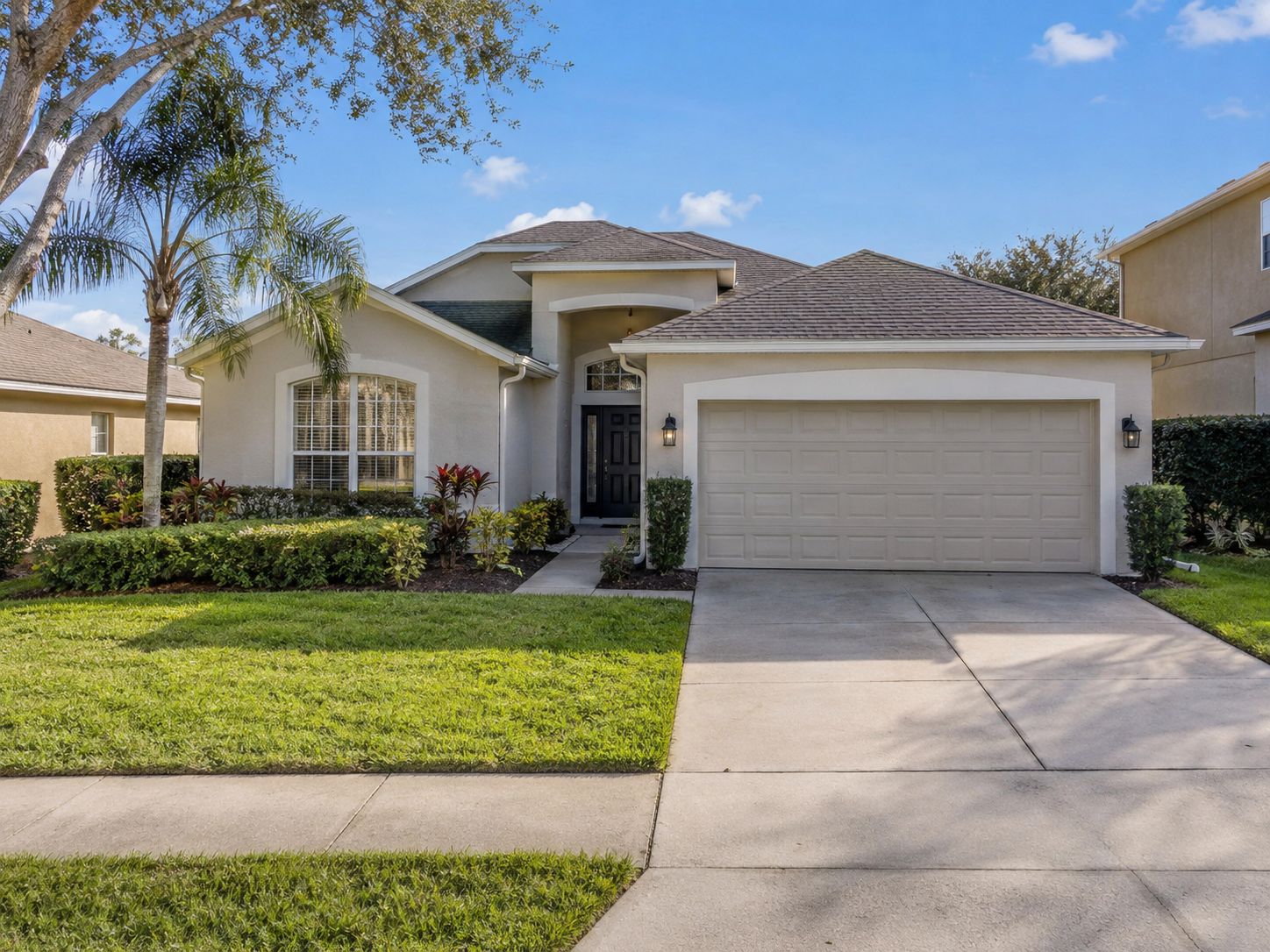
Long-term rentals may not have the same revenue upside as a strong vacation rental, but predictability can be valuable.
With a traditional rental, turnover is typically lower. Tenants may bring their own furniture, utilities can often be structured differently, and the investor is not managing new guests every few days.
The trade-off is less flexibility.
Once someone occupies the property under a residential lease, the relationship is governed by the lease and applicable Florida landlord-tenant laws. The Florida Residential Landlord and Tenant Act covers issues including deposits, maintenance responsibilities, access, and termination.
For investors who want less day-to-day involvement, long-term rentals can be attractive.
But that does not mean every long-term rental is automatically a good deal. Rent still needs to support taxes, insurance, maintenance, vacancy, management, HOA expenses, and reserves.
Which Rental Strategy Has the Best Return?
The strategy with the highest gross revenue does not necessarily produce the best return.
Imagine one property generates $5,000 in gross short-term rental revenue during a strong month while another rents long-term for $3,000.
At first glance, the short-term property looks like the obvious winner.
But the comparison changes once you subtract utilities, cleaning, furniture replacement, platform costs, management, supplies, vacancy, and additional maintenance.
Mid-term rentals have their own gaps between tenants, and long-term properties still experience turnover, repairs, leasing expenses, and vacancy.
I want to know what is left after those expenses.
I also want to know what happens if occupancy is lower than expected, repairs are higher than expected, or the market changes.
A rental strategy should not need every assumption to go perfectly just to break even.
How Do Taxes Change Between Rental Strategies?
Rental length can affect the taxes an investor needs to consider.
Florida generally applies taxes to qualifying rental accommodations rented for six months or less, while counties may impose additional local tourist or transient rental taxes.
For properties in Orange County, the Orange County Comptroller provides information about Tourist Development Tax and qualifying accommodations.
This is particularly important for mid-term investors.
A three-month rental may not feel like a vacation rental, but that does not automatically mean it receives the same tax treatment as a traditional 12-month lease.
When the numbers depend on a particular tax treatment, I would confirm it with the appropriate tax professional rather than build the investment analysis around an assumption.
Does Location Matter More Than the Rental Strategy?
Sometimes it does.
A home near a major Central Florida vacation corridor may have a completely different guest pool than a suburban property primarily surrounded by long-term residents.
A furnished property near major employers, healthcare facilities, transportation, or areas attracting relocating professionals may have stronger mid-term potential.
A traditional long-term rental may depend more on consistent residential demand, reasonable housing costs, employment access, and whether market rent supports the purchase price.
The strategy and property need to fit each other.
Buying first and deciding what kind of rental it should become afterward can create unnecessary risk.
Can an HOA Change the Investment Plan?
Absolutely.
Local government approval and HOA approval are two separate questions.
An association may have rules involving minimum lease periods, rental caps, waiting periods, tenant approval, occupancy, or short-term stays.
Even Orlando’s Home Sharing process notes that additional association requirements may apply when a property is subject to a mandatory HOA.
If rental income is an important part of the purchase decision, I want the actual governing documents reviewed before assuming the strategy works.
Short-Term vs. Mid-Term vs. Long-Term Rental Comparison
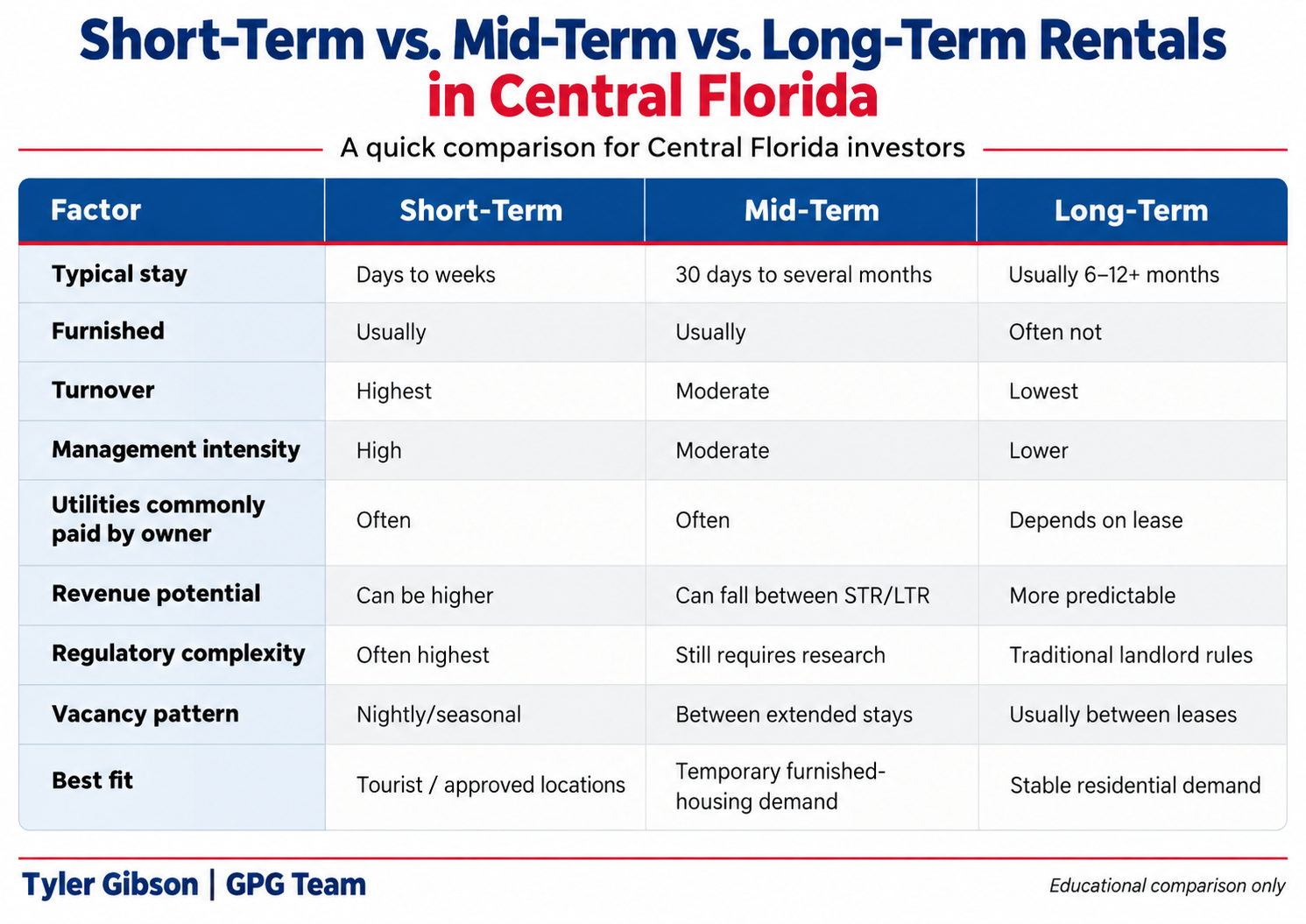
These are broad characteristics, not guarantees. The individual property can change the answer.
Which Strategy Is Best for a Central Florida Investment Property?
There is no single strategy that is best for every investor.
For one property, a vacation rental may make sense. Another may perform better as a furnished 90-day rental. Someone who values predictable occupancy and fewer moving parts may prefer a traditional annual lease.
Before buying, I would answer five questions:
Can the property legally support the strategy? Does the HOA allow it? Is there actual demand for that type of rental? What is the realistic net income after expenses? And if the first strategy stops working, is there a reasonable backup plan?
That last question is important.
A property that only works under one aggressive income assumption leaves very little room for demand, regulations, expenses, or circumstances to change.
Frequently Asked Questions
Are short-term rentals legal in Orlando, Florida?
Short-term rentals are not universally permitted throughout Orlando. The City of Orlando has specific Home Sharing rules, and zoning and private association restrictions can also affect individual properties.
Is a 30-day rental considered short-term in Florida?
Florida lodging law generally distinguishes stays under 30 consecutive days from stays of at least 30 days. However, that threshold does not automatically determine the tax, HOA, zoning, or landlord-tenant treatment of every rental.
Do mid-term rentals pay taxes in Florida?
They can. Qualifying accommodations rented for six months or less may be subject to Florida taxes and applicable local transient-rental taxes, depending on the arrangement and available exemptions.
Do I need a Florida license for a vacation rental?
Qualifying vacation rentals may require licensing through Florida DBPR. Local zoning, tax, and business requirements can also apply.
Can an HOA restrict short-term or mid-term rentals?
Yes. An HOA or condo association may establish minimum lease periods, rental caps, waiting periods, or other restrictions, so investors should review the governing documents before buying.
Which rental strategy is best in Central Florida?
It depends on the property and the investor. Location, legal use, demand, net income, management requirements, and financial goals should drive the decision.
Thinking About Buying a Rental Property in Central Florida?
The mistake is buying a property because one rental strategy looks great on a spreadsheet and investigating the details afterward.
I would rather determine the strategy, understand the realistic numbers and restrictions, and then find a property that fits.
If you are considering an investment property in Orlando or Central Florida, I can help you compare locations, property types, rental strategies, and the due-diligence questions worth answering before you buy.
Categories
Recent Posts









“Making real estate simple, fun and profitable! ”